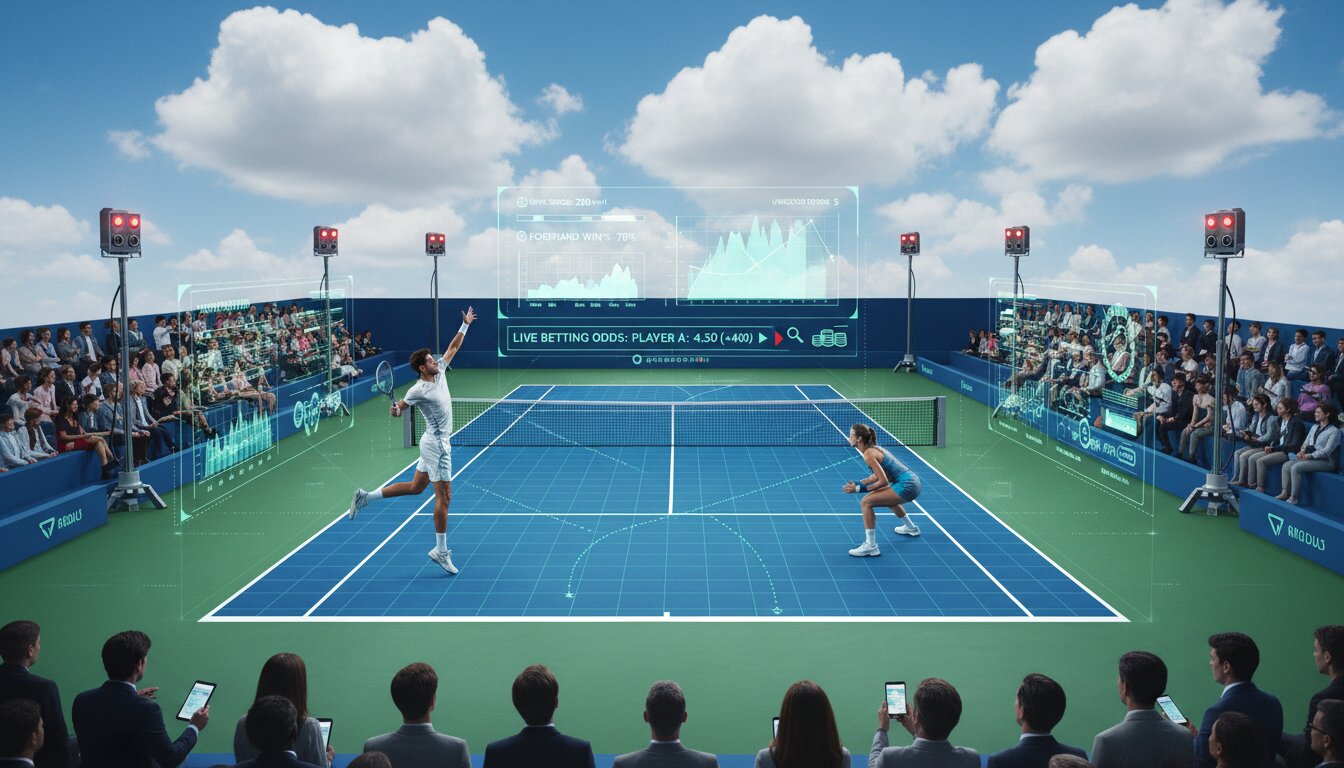
For a long time, tennis numbers were simple. If someone wanted to understand a match, they looked at the ranking, maybe the head-to-head, and a couple of surface stats. First-serve percentage. Break points. Aces. It wasn’t a deep analytical world. It was more like a tidy scoreboard with a few extra columns. Hawk-Eye changed that, though not in the way people first expected.
When it arrived, it was just a line-calling tool. Players challenged a call, the replay showed the ball mark, and the argument ended. That was the whole purpose. Fewer disputes, less guesswork, and a cleaner flow to the match. But once those cameras were installed around the court, it became obvious they were capturing much more than close calls. Every shot was being tracked. Every bounce. Every angle. It wasn’t just a replay system anymore. It was a quiet data engine.
From line calls to full-match data
The system uses several high-speed cameras positioned around the court. Each one tracks the ball from a different angle. Software combines those views to calculate the ball’s path in three dimensions. That is how it can determine whether a shot clipped the line or missed it by a few millimeters. At tournaments like the Australian Open, where matches run from the heat of the afternoon into late-night sessions, the system operates continuously, collecting data from every court in use.
The important part, though, is everything else it sees along the way. Serve speed. Shot depth. Rally length. Court positioning. All of it gets recorded. Over a single match, that becomes thousands of data points. Over a full event like the Australian Open, it turns into a massive archive of performance information built across hundreds of matches. Coaches use it to study patterns. Broadcasters turn it into graphics. And betting models quietly feed on it in the background.
Odds built on more than just the score
Traditional betting models leaned heavily on surface-level indicators. Rankings, recent form, past meetings. Those still matter, but they do not tell the whole story. On platforms like betway, the shift toward live markets and faster updates has made deeper performance data more important than ever, because the odds have to reflect what is happening point by point, not just what happened last week.
Tracking studies have shown, for example, that speed and trajectory have a strong impact on point outcomes. A small drop in pace or accuracy can shift a player’s effectiveness across an entire set. That kind of change does not always show up immediately on the scoreboard, but the data can spot it early.
So instead of reacting only to the score, modern models can react to performance signals. Is the first serve losing speed. Are rallies getting longer on one side? Is one player consistently being pushed behind the baseline. Those details start to influence the odds as the match unfolds, especially in live environments where platforms adjust prices continuously in response to the underlying flow of the match.
Real-time prediction during play
Research using in-match data suggests that models can predict match outcomes with surprising accuracy using only early-match indicators. Some machine-learning systems reach well above seventy percent accuracy once enough point-level data is available. That is where tracking systems become valuable for live betting. They provide a constant stream of small signals. Imagine a player who is down a set. On paper, it looks like trouble. But the data shows that players are winning more points in rallies over five shots, or producing higher average serve speeds. That might suggest the match is drifting in a different direction than the score suggests.

 Tech is changing the game as technology is powering the boom in online sports betting
Modern markets pick up on those hints. Odds shift not just because of what has happened, but because of what the data implies might happen next.
Fewer swings caused by officiating
Electronic line-calling also removed a layer of unpredictability. Before tracking systems, a missed call at a crucial moment could flip a game or even a set. It was part of the sport, but it introduced noise that had nothing to do with performance. With automated calls, most of those moments disappear. The environment becomes more stable. For betting models, that stability is useful. Fewer unexpected swings means the odds can reflect actual play instead of controversial decisions.
The growth of point-level markets
Another change followed naturally from all this data. Betting markets became smaller and faster. Instead of focusing only on match winners or set scores, platforms started offering wagers on the next point, the next break of serve, or the outcome of a tie-break. These markets depend on instant, accurate updates. Tracking systems provide that speed. Every point is confirmed immediately. Every outcome feeds straight into the pricing models. Without that level of detail, these micro-markets would be much harder to run.
Data as a business asset
As tracking systems became central to the sport, the data itself gained value. Tournaments and governing bodies realized that real-time performance feeds could be licensed to betting operators. In some cases, the data streams became nearly as important as broadcast rights. The cameras around the court were no longer just there to settle line calls. They had become part of the sport’s commercial backbone.
A subtle feedback loop
There is also a quiet cycle taking place now. Coaches study tracking reports and adjust tactics. Players change their patterns. Those changes appear in the data. Betting models absorb the new trends and reflect them in the odds. Over time, that loop tightens the link between performance and probability. Markets become more sensitive to small shifts, and players become more aware that every shot is being measured.
Where it might go next
Tracking technology is still evolving. Some experiments already combine ball data with detailed movement analysis. Others look at biomechanics or fatigue patterns. If that information starts feeding into live models, betting markets could become even more responsive. Odds might react not just to rally outcomes, but to how efficiently a player is moving or how their serve mechanics are changing late in a set.
The quiet influence behind modern odds
Hawk-Eye entered tennis to answer a simple question. Was the ball in or out. That was the promise. Now the same cameras help power predictive models, live odds, and point-by-point markets. They turned tennis into a sport where every shot produces data, and every piece of data can shape probability. Modern tennis betting still looks familiar on the surface. There are still favorites and underdogs. Still match winners and set scores. But underneath, much of the decision-making now runs on the silent stream of tracking data flowing from the cameras around the court.